Using AieonFounder to Help Guide My Startup

If you are like me, you’ve thought up countless business ideas while reflecting on a problem or demand in your community, daydreaming during boring work meetings, or shooting the bull with friends. Most of these ideas never go anywhere, and many of them probably shouldn’t. But some golden nuggets are cut short by a lack of direction or a poor understanding of personal skills, resources, and goals.
This is where AieonFounder offers an interesting approach.
AieonFounder is designed to help users discover business ideas that fit who they are. Instead of asking people to randomly brainstorm or copy whatever business trend is popular at the moment, the service focuses on matching ideas to the individual. That matters because a good business idea is not just about market demand. It also needs to match the founder’s strengths, interests, skills, energy, and goals. A business may look profitable from the outside, but if it does not fit the person building it, it can quickly become frustrating, unsustainable, and, eventually, abandoned.
I was originally going to write about the idea AieonFounder guided me toward on my first time using the service… But I’ve decided against it - I like it too much to share! So, I worked through the free trial again with a slightly shifted focus on tech support.
The process started with 20 randomized questions. Some were multiple choice, while others were fill-in-the-blank. The questions covered my ideal work environment, work history, interests, location, startup budget, and how many hours I could realistically commit. The most interesting question asked, “What are you willing to sacrifice?” That one took me by surprise, but it pushed me to think more seriously about what building a business would actually require.
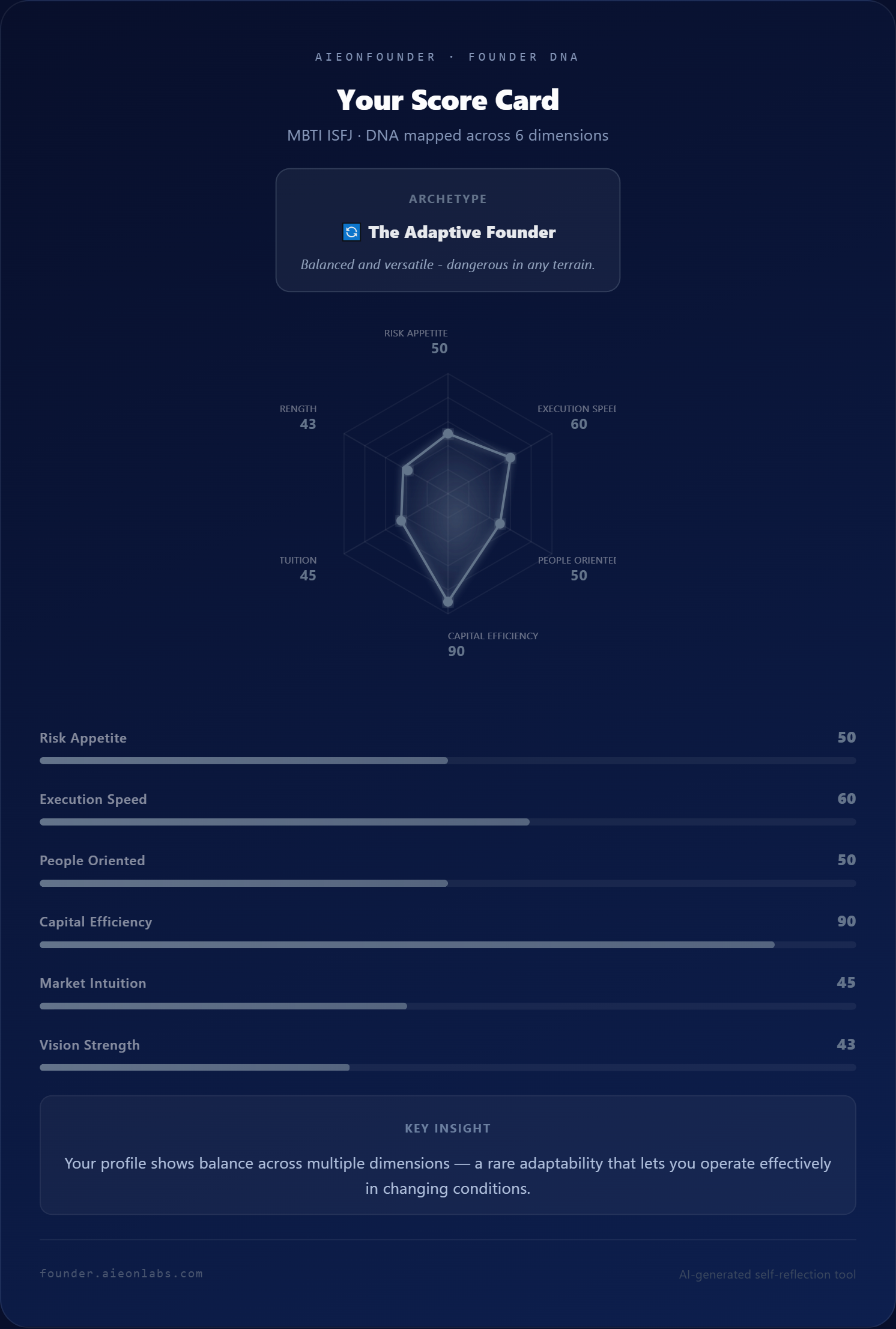
After the questions, AieonFounder gave me a founder scorecard. I was labeled “The Adaptive Founder,” with scores across areas like risk appetite, execution speed, people orientation, capital efficiency, market intuition, and vision strength. This part made the rest of the output feel more personal. It was not just throwing random ideas at me. It was framing the ideas around how I might actually operate as a founder.
The business idea I chose to explore was a home tech support service for older adults. We all know older people who struggle with anything tech, including phones, tablets, computers, and TVs. staying connected with family. AieonFounder connected the idea to my actual strengths with a concept that was specific, practical, and closely tied to my background. This included experience with older adults, understanding of cognitive challenges, tech comfort, and local community knowledge.
This personalization is important; it did not suggest a random dropshipping store, generic consulting business, or trendy online side hustle. It gave me a business direction that made sense for me. It also gave specific action steps. For example, it suggested partnering with a local faith community, offering a free short tech-help event, and using that to build trust and collect leads. That is much more useful than vague advice like “start networking” or “market your service.” It gave me a first move.
Another strong feature was the competitor breakdown. AieonFounder identified obvious competitors like Geek Squad, local repair shops, and freelance tech helpers. But it also pointed out indirect competitors, like family members, libraries, senior centers, and free online resources. That matters because sometimes your biggest competitor is not another business- it is the free option people already use.
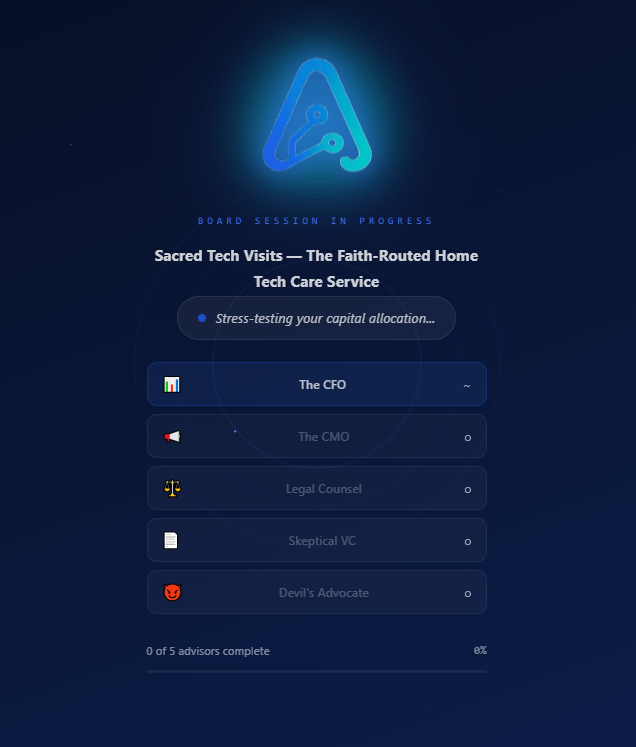
The “AI Board” was my favorite part; different advisor cards reviewed the idea from different angles: finance, marketing, legal risk, investor concerns, and a Devil’s Advocate section. The Devil’s Advocate was especially useful because it challenged the idea instead of just praising it. It pointed out risks like limited time, existing competition, narrow positioning, liability concerns, and the need to prove people would actually pay. In fact, it was a bit brutal, but sometimes the truth hurts, and nothing said was unreasonable.
That is important because AieonFounder is not a finished business plan. It is not legal advice, financial advice, or proof that a market exists. The output still needs real-world testing. You would need to talk to customers, test prices, review local competitors, check insurance needs, and see whether people are actually willing to pay.
Still, as an early-stage idea tool, I found it genuinely useful. It helped turn a broad interest into a more specific business concept, then pushed that concept through practical questions, possible competitors, advisor-style feedback, and next steps.
AieonFounder’s strength is not that it magically builds a business for you. Its strength is that it helps you move from “I have an idea” to “Here is a direction I can actually test.” For aspiring founders, that clarity can be the difference between another forgotten idea and a real first step.