Brief History of Bitcoin (BTC)
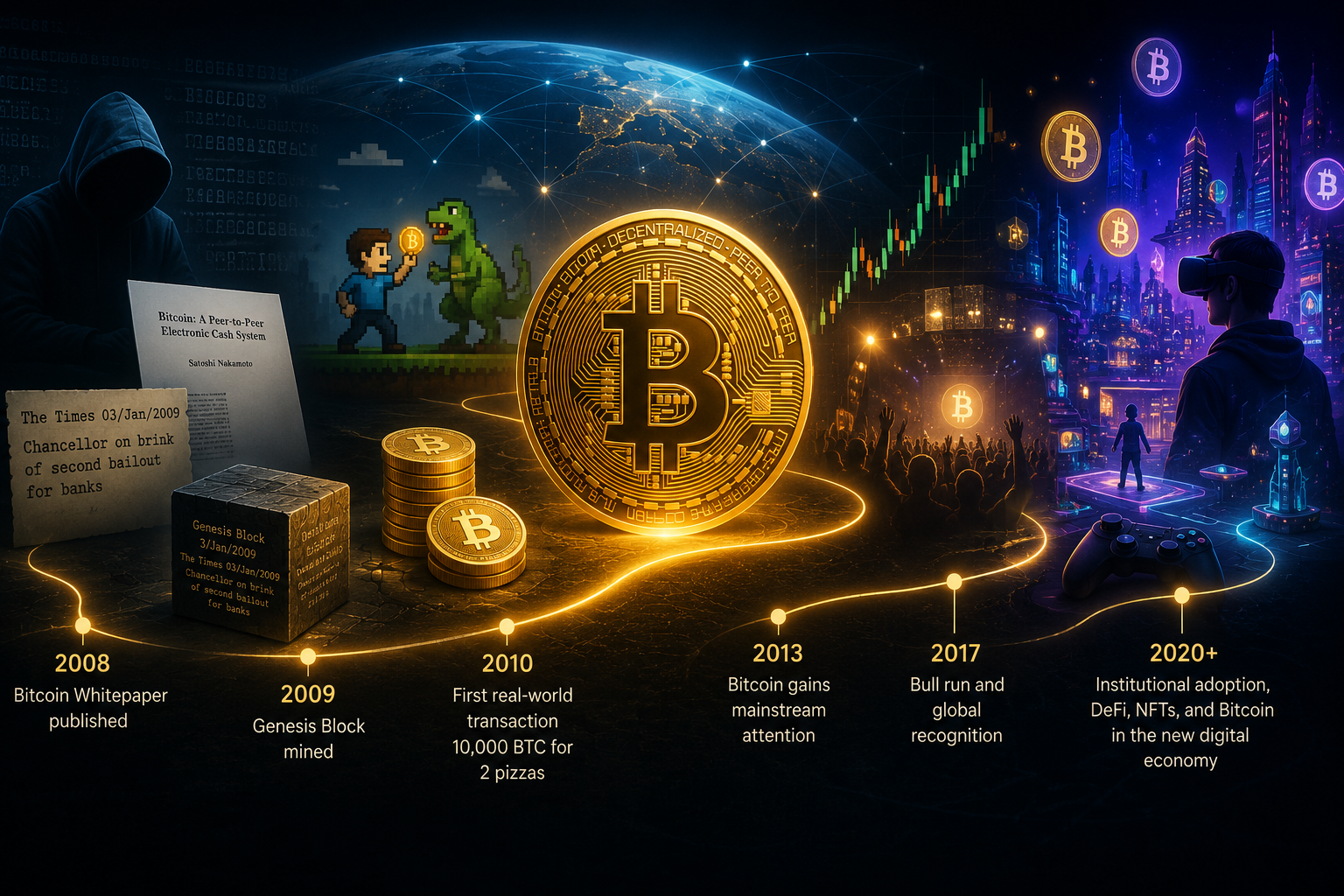
Bitcoin (BTC) is the first widely successful cryptocurrency. It was introduced as a way to send digital money directly from one person to another without relying on a bank or payment company.
The White Paper: 2008
Bitcoin began in 2008 when someone using the name Satoshi Nakamoto published the Bitcoin white paper, titled Bitcoin: A Peer-to-Peer Electronic Cash System. The paper described a system for online payments that could work without a trusted third party, using a public record of transactions and proof-of-work to help prevent double spending. (Bitcoin)
This was important because earlier attempts at digital money struggled with the problem of copying or spending the same digital coin twice. Bitcoin’s design offered a way for a network of users to agree on transaction history without one central owner.
The Network Launch: 2009
Bitcoin went live in January 2009. The first block, called the genesis block, was created by Satoshi Nakamoto on January 3, 2009. This block included a message referencing a newspaper headline about bank bailouts, which many people view as a clue to Bitcoin’s original purpose: creating money outside the traditional banking system. (Investopedia)
In the early days, Bitcoin was mostly used by programmers, cryptography fans, and people interested in financial independence. It had little market value at first.
The First Real-World Purchase: 2010
In May 2010, Bitcoin had one of its most famous early moments. Programmer Laszlo Hanyecz paid 10,000 BTC for two pizzas. This became known as Bitcoin Pizza Day and is often remembered as the first major real-world purchase using Bitcoin. (Bitcoin Magazine)
At the time, the point was not that Bitcoin was expensive. It was that Bitcoin could actually be used as money between real people.
Growth, Crashes, and Wider Attention
From 2011 through 2017, Bitcoin grew from a niche internet experiment into a global financial asset. Exchanges formed, prices rose and crashed, and more people began buying it as both a payment network and a store-of-value idea.
This period also brought major problems. Exchange hacks, scams, and custody failures showed that while the Bitcoin network itself was designed to be decentralized, the companies around it could still fail.
Halvings and Scarcity
Bitcoin has a fixed maximum supply of 21 million coins. New BTC enters circulation through mining rewards, and those rewards are cut in half roughly every four years. This event is called a halving.
The most recent Bitcoin halving happened on April 20, 2024, at block 840,000, reducing the block reward from 6.25 BTC to 3.125 BTC. (CoinGecko)
Bitcoin Today
By the 2020s, Bitcoin had become much more mainstream. Large financial firms, public companies, and investment funds started paying closer attention. In January 2024, the U.S. SEC approved the listing and trading of several spot Bitcoin exchange-traded products, giving investors another way to gain exposure through traditional markets. (Securities and Exchange Commission)
Not financial advice. Educational purposes only.