Investing Across Crypto Sectors: L1s, L2s, DeFi, NFTs, Infra, & More
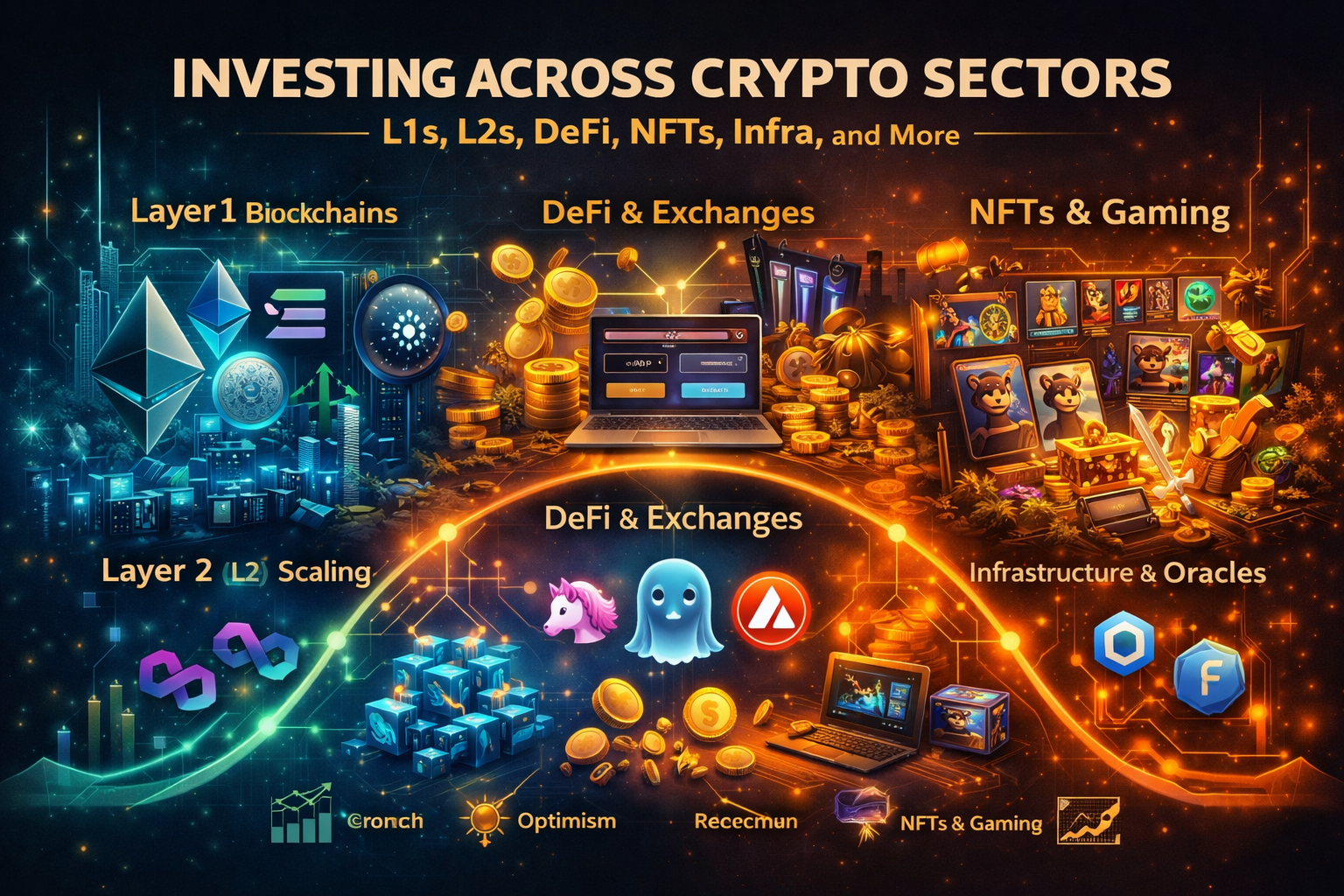
What Is a Crypto Sector?
A crypto sector is a category of projects that do similar things.
Just like stocks have sectors such as technology, healthcare, and energy, crypto has sectors too. Each sector solves a different problem, attracts different users, and may perform differently at different times.
Looking at sectors helps you ask a better question than just, “Will this coin go up?” It helps you ask, “What part of crypto is this project actually in, and what drives demand there?”
Common Crypto Sectors i
L1s (Layer 1 blockchains)
These are the base blockchains where transactions and apps run.
Examples of what L1s try to offer:
Security
Speed
Decentralization
A place for developers to build
Investing in an L1 is often a bet on the growth of that whole ecosystem.
L2s (Layer 2 networks)
These are networks built on top of an L1 to help make transactions faster or cheaper.
They matter because base chains can get crowded and expensive. L2s try to improve scale while still relying on the underlying chain in some way.
DeFi (decentralized finance)
DeFi projects offer financial tools without traditional banks.
Examples include:
Trading
Lending
Borrowing
Yield products
DeFi can be useful, but it also brings smart contract risk, liquidation risk, and complex incentives.
NFTs (non-fungible tokens)
NFTs are unique digital items recorded on a blockchain.
They are often linked to:
Art
Collectibles
Gaming items
Access or membership rights
NFTs can be highly emotional and trend-driven, with prices heavily shaped by culture and community interest.
Infra (infrastructure)
Infrastructure projects support the rest of crypto behind the scenes.
This can include:
Oracles
Data tools
Wallet tools
Cross-chain systems
Developer platforms
Infra may get less hype than consumer-facing projects, but it can be important if the wider ecosystem grows.
And more
There are many other sectors too, such as gaming, AI-related tokens, DePIN, privacy projects, real-world assets, and stablecoin systems. New sectors appear often, especially during strong market cycles.
Why Sector Thinking Matters
Different sectors react to different drivers.
For example:
An L1 may depend on ecosystem growth and developer activity.
A DeFi token may depend on trading volume, fees, or locked value.
An NFT project may depend more on community attention than technical use.
This means two tokens can both be “crypto” while behaving very differently.
Risks of Investing Across Sectors
Sector investing can help you understand the market better, but it does not remove risk.
Key risks include:
Chasing hot narratives instead of real quality
Owning too many projects you do not understand
Assuming every sector winner will survive long term
Buying weak projects just because the sector is popular
A strong sector can still contain bad tokens.
Takeaway
Investing across crypto sectors means recognizing that crypto is made up of different categories with different goals, users, and risk profiles. L1s, L2s, DeFi, NFTs, and infrastructure all play different roles in the ecosystem. As a beginner, sector thinking can help you ask smarter questions, compare projects more fairly, and avoid treating every crypto asset like the same kind of investment.
Not financial advice. Educational purposes only.