Key Ratios Beginners Hear About
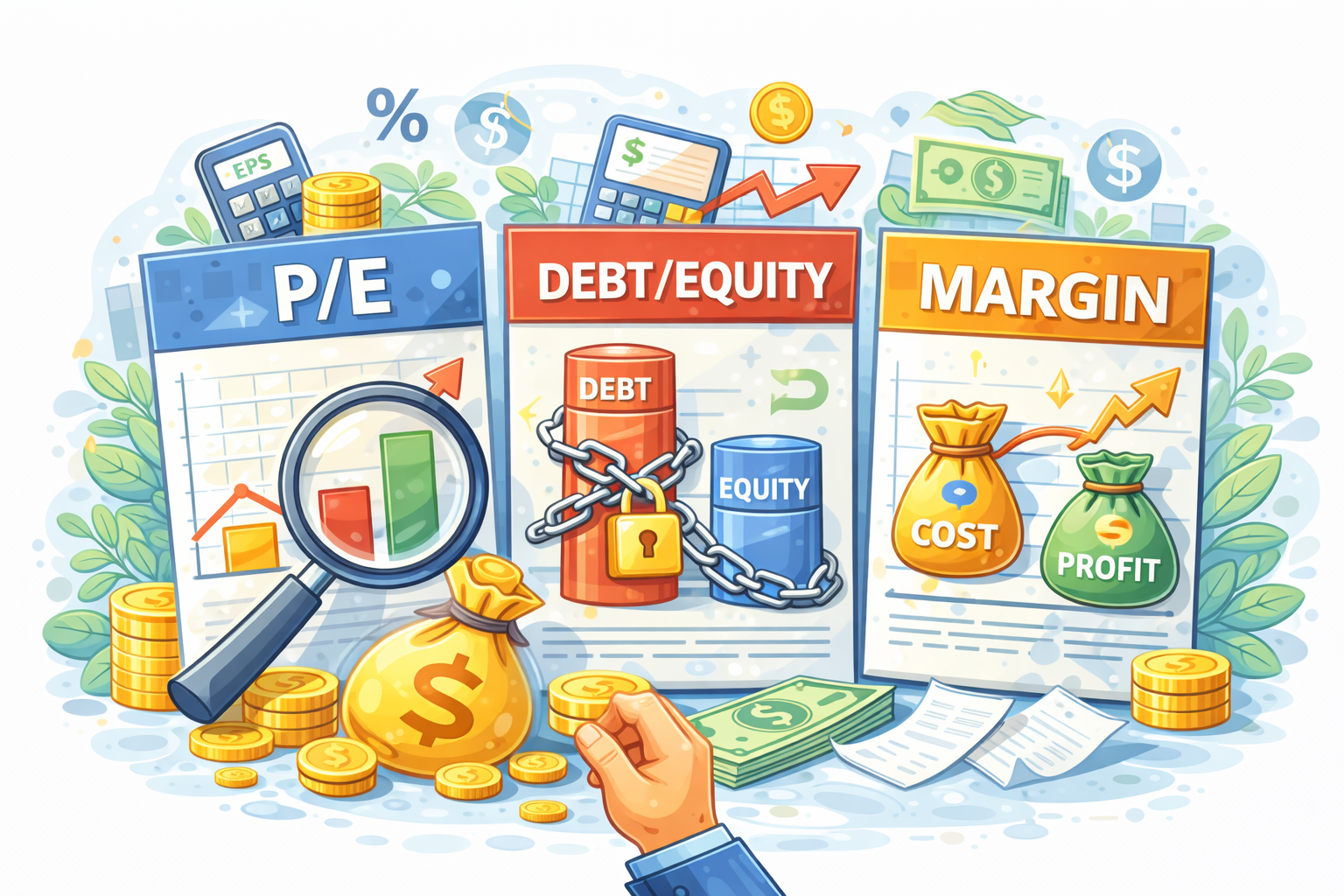
When people talk about “analyzing stocks,” they often mention a few basic numbers called financial ratios. These include the P/E ratio, debt-to-equity ratio, and profit margin. Understanding a few key financial ratios for beginners can help you read company summaries and news with more confidence.
What Are Financial Ratios?
A financial ratio is a simple math comparison between two numbers from a company’s financial statements.
Ratios help you answer questions like:
How expensive is this stock compared to its earnings?
How much debt does this company use?
How much profit does it keep from each dollar of sales?
They are tools, not final answers.
P/E Ratio (Price-to-Earnings)
The P/E ratio (price-to-earnings) compares a company’s stock price to its earnings per share (EPS).
A simple formula is: P/E ratio = Share price ÷ Earnings per share
If a stock is $20 and EPS is $2, the P/E is 10. That means investors are paying $10 for every $1 of yearly earnings.
A higher P/E can mean investors expect more growth.
A lower P/E can mean the stock is cheaper, or that investors see more risk.
P/E ratios vary by sector and market conditions, so “high” or “low” depends on context.
Debt-to-Equity Ratio
The debt-to-equity ratio compares how much debt a company has to how much equity (owner’s capital) it has.
A simple formula is: Debt-to-equity = Total debt ÷ Total equity
A higher debt-to-equity ratio means the company uses more borrowed money.
A lower debt-to-equity ratio means it relies more on its own capital.
Debt can help a business grow, but too much debt raises risk if earnings fall or interest rates rise. Different industries also have different “normal” levels of debt.
Profit Margin (Margin)
Profit margin shows how much profit a company keeps from each dollar of sales.
A simple version is net profit margin: Net margin = Net income ÷ Revenue
If a company makes $10 in profit on $100 in sales, its net margin is 10 percent.
Higher margins suggest the company keeps more from each sale.
Lower margins suggest more costs, lower pricing power, or both.
Margins can change over time with competition, costs, and business strategy.
Benefits and Limits of Ratios
Benefits:
Quick way to compare companies.
Help you think about price, risk, and profitability.
Limits:
Ratios are based on past data.
They can look better or worse in different industries.
A “good” ratio does not guarantee a good investment.
Takeaway
P/E, debt-to-equity, and profit margin are common ratios beginners will hear often. They help you think about how expensive a stock is, how much debt a company uses, and how profitable it is. Use them as simple tools, remember their limits, and keep in mind that all investments can go up or down in value.