Market Orders vs Limit Orders (and Why It Matters)
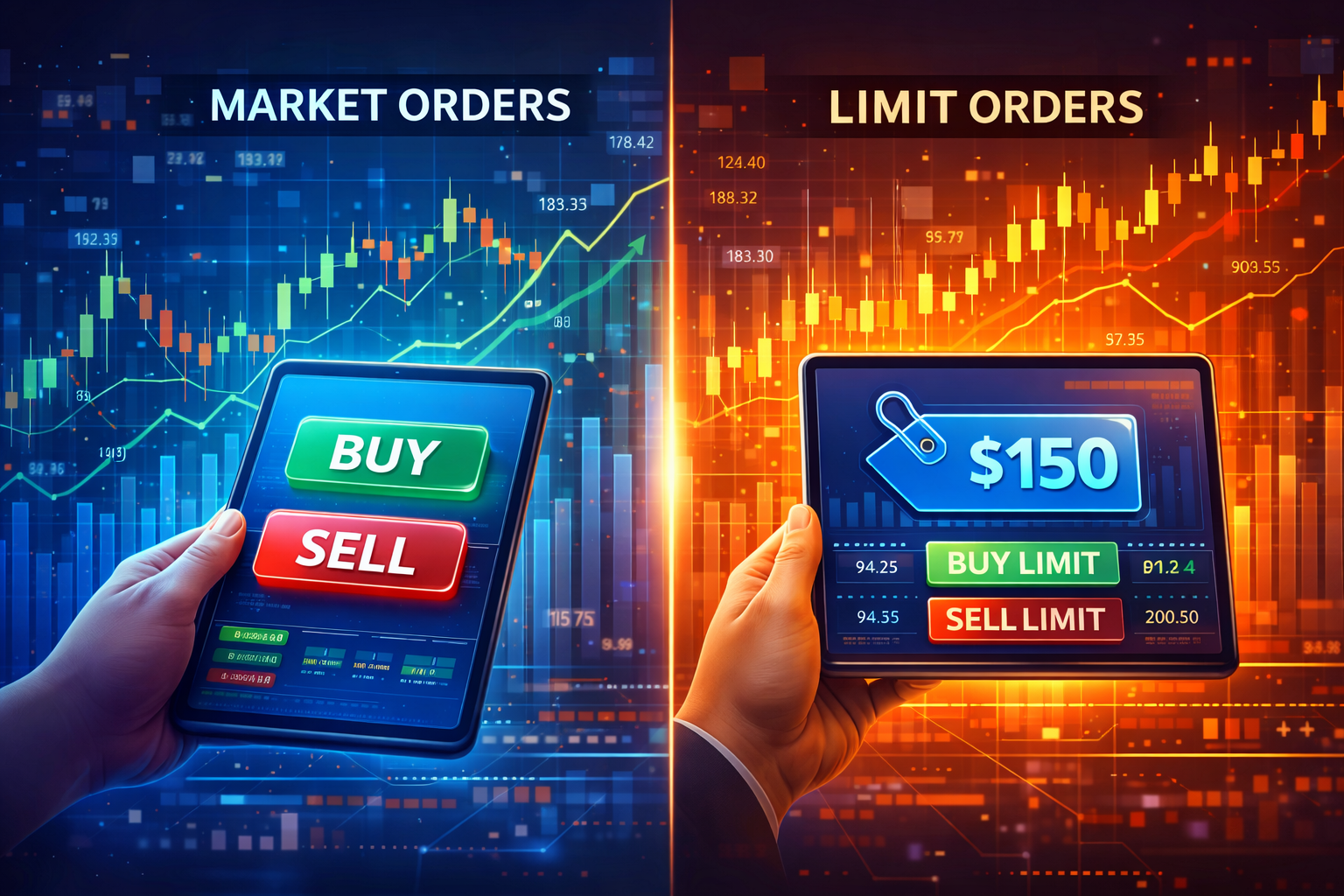
When you place a trade, your broker will ask how you want the order handled. Two of the most common choices are market orders and limit orders. Understanding market orders vs limit orders helps beginners control how quickly a trade happens and what price they might actually pay or receive.
What Is a Market Order?
A market order tells your broker: “Buy (or sell) this stock as soon as possible at the best available price.”
Key points:
Priority is speed, not exact price.
During normal market hours, market orders usually fill quickly.
The final price can be slightly higher or lower than the last price you saw, especially if the stock is moving fast.
Market orders are often used when:
The stock is very liquid (lots of trading and tight bid–ask spreads).
You care more about getting in or out now than about a specific price.
Risk: In less-liquid or very volatile stocks, a market order can fill at a price that is worse than you expected.
What Is a Limit Order?
A limit order tells your broker: “Buy (or sell) this stock, but only at this price or better.”
Examples:
Buy limit order: “Buy at $25 or lower.”
Sell limit order: “Sell at $25 or higher.”
Key points:
Priority is price control, not speed.
Your order only fills if the market reaches your limit price or better.
There is no guarantee your order will execute.
Limit orders are often used when:
You want to avoid paying more than a certain price.
The stock is more volatile or not very liquid.
You are patient and willing to wait for your price.
Risk: If the stock never reaches your limit, your order may never fill, and you could miss the trade entirely.
Why This Choice Matters
For beginners, the trade-off is simple:
Market order
More certainty that the order will fill.
Less certainty about the exact price.
Limit order
More certainty about the maximum (or minimum) price.
Less certainty that the order will fill at all.
A helpful way to frame it:
Market order: “Just get it done.”
Limit order: “Get it done, but only if I can get this price or better.”
Neither is always “right” or “wrong.” They are tools for different situations, and both still involve risk because stock prices can move after your trade.
Takeaway
Market orders focus on speed and usually fill quickly, but you give up some control over the final price. Limit orders focus on price control, but they might not fill if the market never reaches your chosen level. For beginners, knowing when to use each can reduce unwanted surprises and reinforce that any investment can go up or down after you place an order.