Target-Date Funds
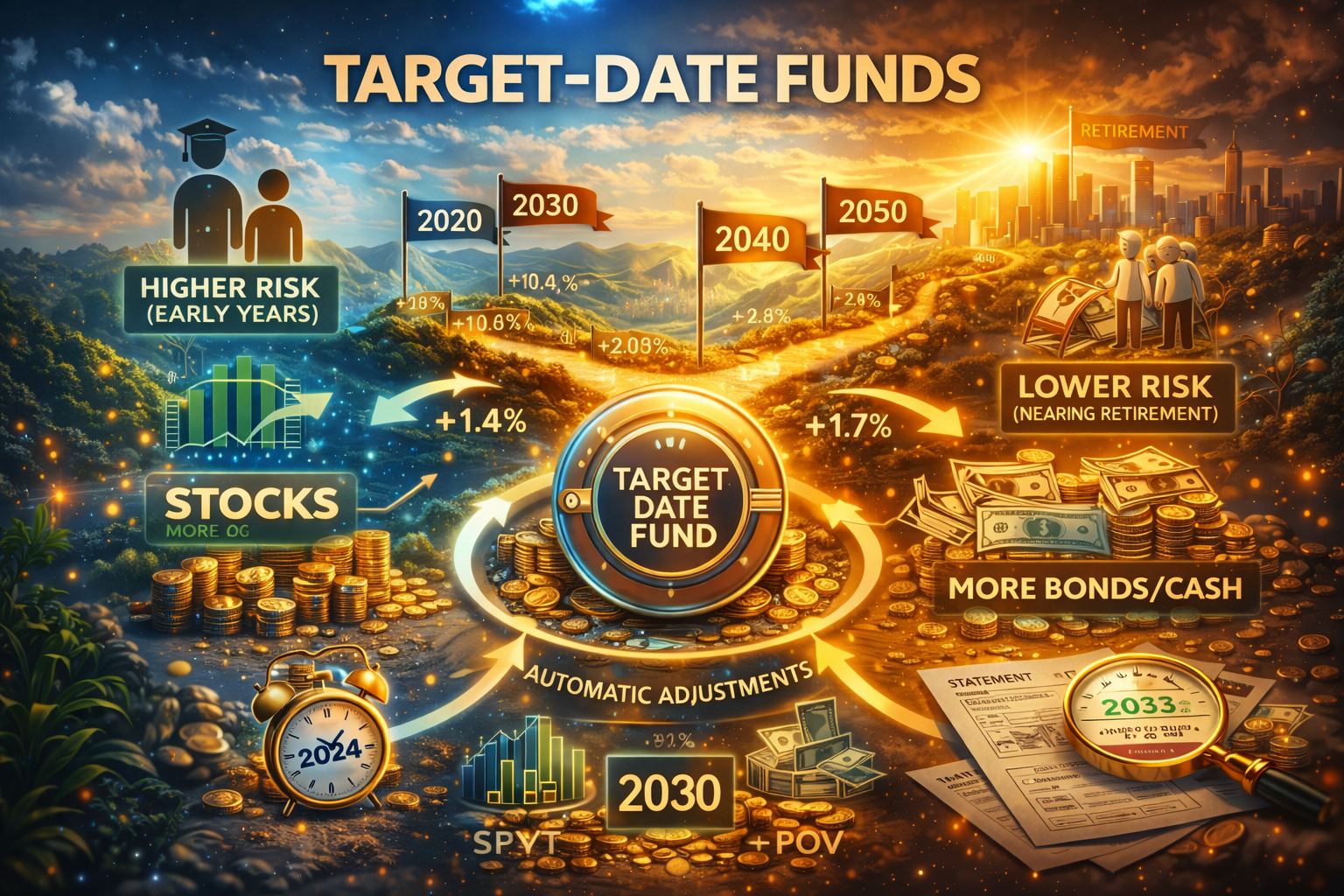
What Is a Target-Date Fund?
A target-date fund is a fund built around a future year, usually the year an investor expects to retire or begin using the money.
For example, a person planning to retire around 2060 might look at a target-date fund with “2060” in its name. The fund manager uses that date as a guide for how the money is invested.
These funds usually hold a mix of:
Stocks
Bonds
Sometimes cash or other investments
Instead of choosing and adjusting each part yourself, the fund does that for you.
How Target-Date Funds Work
Target-date funds are designed to become more conservative over time.
When the target date is far away, the fund often holds more stocks because stocks usually offer more growth potential, but also more ups and downs.
As the target year gets closer, the fund usually shifts toward:
More bonds
Sometimes more cash
Less stock exposure
This gradual change is often called the fund’s glide path. The idea is to take more risk when time is long and reduce risk as the time to use the money gets closer.
Why Beginners Hear About Them Often
Target-date funds are common in retirement accounts because they offer a simple, more hands-off approach.
Potential benefits:
Simplicity: One fund can provide a full mix of investments
Automatic adjustment: The fund changes over time without you having to rebalance it yourself
Diversification: Many target-date funds hold a broad range of assets
Convenience: Useful for people who do not want to manage multiple funds
Risks and Tradeoffs
Target-date funds are simple, but they are not perfect.
Potential risks and drawbacks:
Still lose value: A target-date fund can fall in a market downturn
One-size-fits-many, not one-size-fits-all: The same target year may not fit every person’s risk tolerance or goals
Fees vary: Some target-date funds cost more than others
Different glide paths: Not all target-date funds become more conservative in the same way
That means two funds with the same target year can still hold different mixes and carry different risks.
Why This Matters for Beginners
For beginners, target-date funds can reduce decision fatigue. Instead of picking separate stock funds, bond funds, and rebalancing plans, one fund handles most of that work.
Still, it is important to know what the fund holds, how aggressive or conservative it is, and what fees it charges. A target-date fund is a tool for simplicity, not a guarantee of returns or safety.
Takeaway
A target-date fund is a single fund built around a future year, often for retirement, that automatically shifts from more growth-focused investments to more conservative ones over time. For beginners, it can be a simple way to get diversification and automatic adjustments in one place. The key is to understand the target year, the fund’s glide path, its costs, and that it can still go up or down in value.
Not financial advice. Educational purposes only.