Market Order vs Limit Order in Crypto
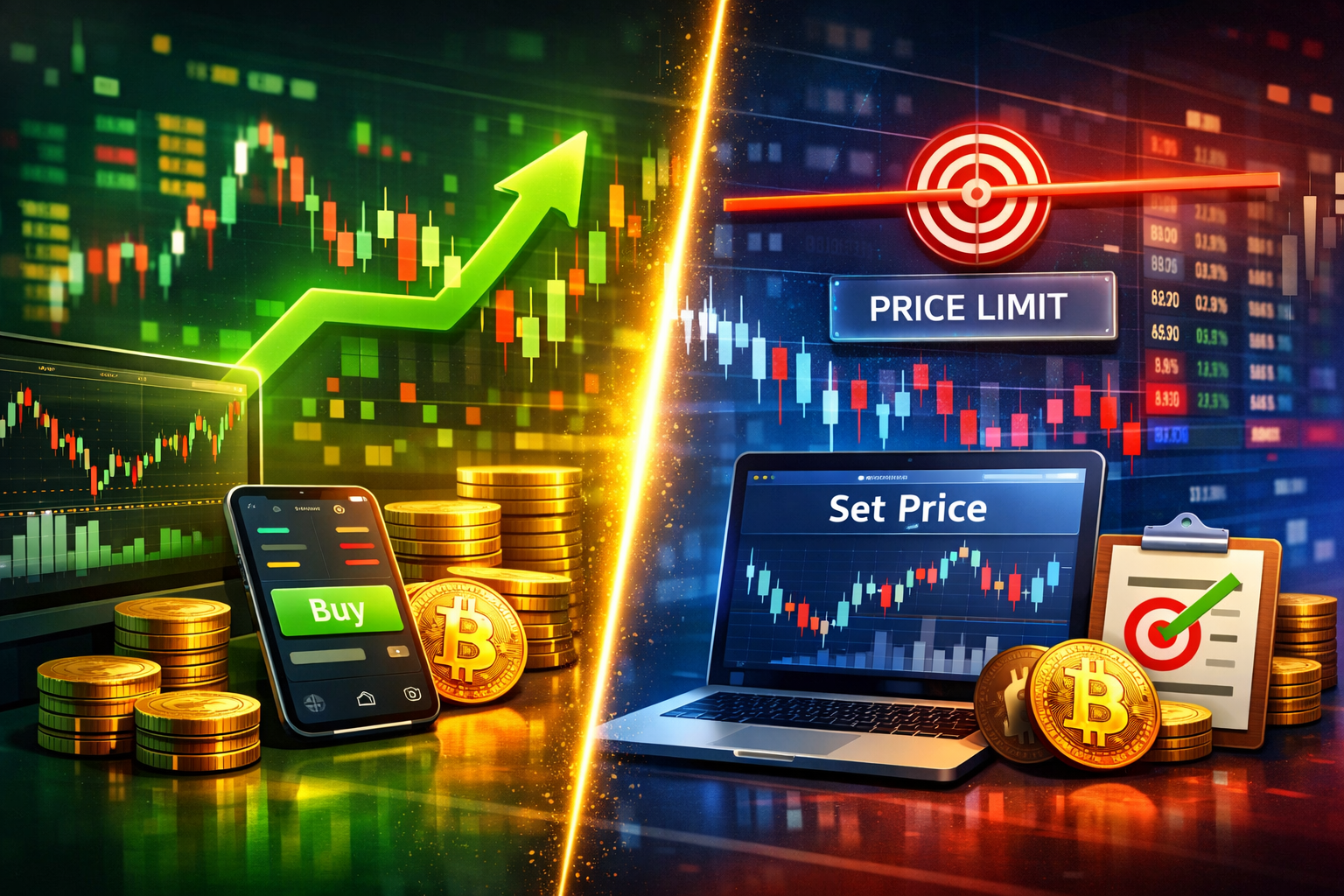
When you buy or sell crypto, the type of order you choose affects the price you get. Two of the most common order types are market orders and limit orders. Understanding market order vs limit order is especially important with low-liquidity tokens, where prices can move fast and fills can get ugly.
What Is a Market Order?
A market order tells the exchange: “Buy or sell right now at the best available price.” This is the fastest way to trade. You are choosing speed over price control.
That means:
Your order fills quickly if there are enough buyers or sellers.
The final price may be different from the one you saw a moment earlier.
Market orders are simple, but they can become expensive when the market is thin.
What Is a Limit Order?
A limit order tells the exchange: “Buy or sell only at this price or better.” You choose the maximum price you are willing to pay when buying, or the minimum price you are willing to accept when selling.
That means:
You get more control over price.
Your order may not fill right away.
It may only fill partly, or not at all, if the market never reaches your chosen price.
Limit orders trade speed for precision.
The Main Difference
The simplest way to think about it:
Market order: Guarantees execution more than price.
Limit order: Guarantees price more than execution.
Both can be useful, depending on the situation. But the risks change a lot in low-liquidity tokens.
Why It Matters in Low-Liquidity Tokens
Low liquidity means there are not many buy and sell orders near the current price.
In these markets, a market order can “eat through” multiple price levels very quickly.
This can cause:
Slippage: You get a worse price than expected.
Price impact: Your own order pushes the price up or down.
Wide spreads: There may be a big gap between the best buy and best sell price.
Example: A token looks like it is trading at $1.00.
But if there are only a few sell orders near that level, a market buy might fill part of your order at $1.00, part at $1.05, and part at $1.12.
The larger your order is compared to the market’s liquidity, the worse this can get.
With a limit order, you could say: “I will only buy at $1.00 or less.”
That protects you from overpaying, but the trade may not happen.
When Beginners Should Be Careful
Low-liquidity tokens are where many beginners get surprised.
Be extra careful when:
Trading small-cap or newer tokens.
Buying after a sudden pump.
Selling during panic, when buyers disappear.
Placing orders that are large compared with normal trading volume.
In these cases, a market order can cost much more than expected.
Takeaway
A market order is about speed, while a limit order is about price control. In high-liquidity markets, the difference may feel small. In low-liquidity tokens, it can be huge. Before trading smaller or thinner coins, check the order book, think about slippage, and remember that a fast fill is not always a good fill.
Not financial advice. Educational purposes only.