Diversification vs Over-Diversification
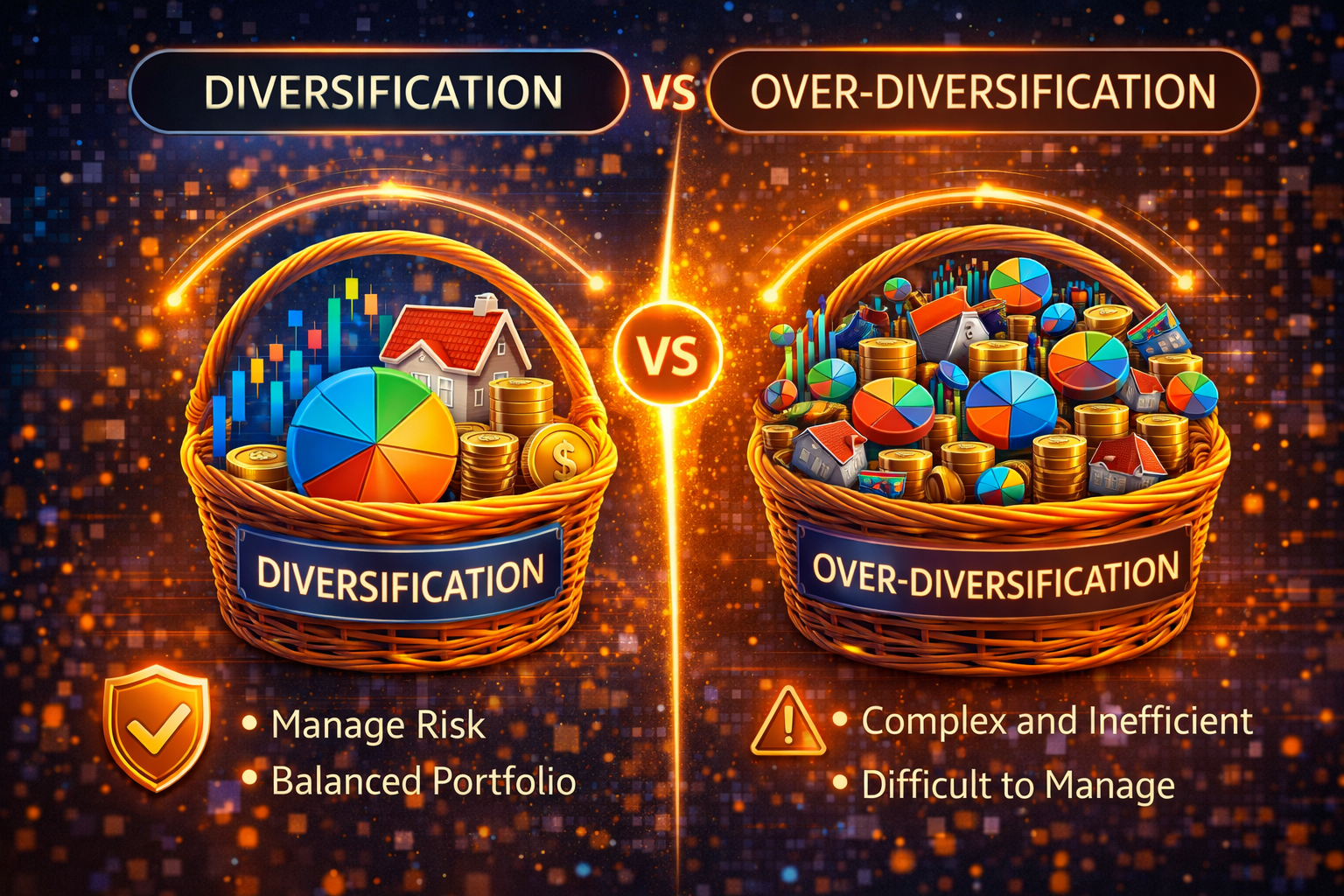
Diversification is usually seen as a good thing in investing. It helps spread risk across different investments instead of depending too much on one. But there is also a point where adding more holdings may not add much benefit. Understanding diversification vs over-diversification helps beginners see the difference between reducing risk and creating a portfolio that becomes harder to manage without much extra value.
What Is Diversification?
Diversification means spreading your money across different investments, sectors, asset classes, or regions. The goal is to reduce concentration risk, which is the risk of having too much tied to one company, one industry, or one part of the market. For example, diversification can mean owning:
Many companies instead of one stock
Different sectors instead of only technology
A mix of stocks, bonds, and cash instead of only one asset class
This helps because different investments do not always move in the same way at the same time.
What Is Over-Diversification?
Over-diversification happens when you keep adding investments, but they do not meaningfully improve your risk spread.
At that point, you may end up with:
Too many overlapping funds or stocks
A portfolio that is harder to understand
Returns that simply copy the broad market in a more complicated way
More effort without much added benefit
For example, someone might think they are highly diversified because they own five different large-cap U.S. stock funds. But if those funds hold many of the same companies, the real diversification may be much smaller than it appears.
Why Investors Diversify
Investors diversify because:
One company can fail
One sector can go through a slump
One country’s market can struggle
Different asset classes may respond differently to bad news or economic changes
Diversification helps reduce the damage from any one problem. It is a way to manage uncertainty, not remove it.
When Diversification Turns Into “Too Much”
Diversification may become over-diversification when:
You add holdings mainly for the sake of having more holdings
Most of your funds own very similar investments
You no longer know what you actually own
The portfolio becomes difficult to rebalance or track
You expect “more holdings” to automatically mean “less risk,” even when the holdings overlap heavily
A portfolio can look busy and still be poorly diversified. It can also look simple and still be well diversified.
Why This Matters for Beginners
Beginners sometimes worry that a simple portfolio must be incomplete. But more investments do not always mean a better setup. A broad index fund or a few well-chosen funds can often provide more useful diversification than a long list of overlapping holdings.
The key question is not “How many holdings do I have?” It is “How different are the investments I own, and what risks do they actually cover?”
Takeaway
Diversification helps reduce concentration risk by spreading money across different investments. Over-diversification happens when adding more holdings makes a portfolio more complicated without adding much real risk reduction. For beginners, the goal is not to own everything possible. The goal is to understand what you own, avoid too much overlap, and build a mix that makes sense for your time horizon and risk level.
Not financial advice. Educational purposes only.