How to Read a Basic Stock Quote
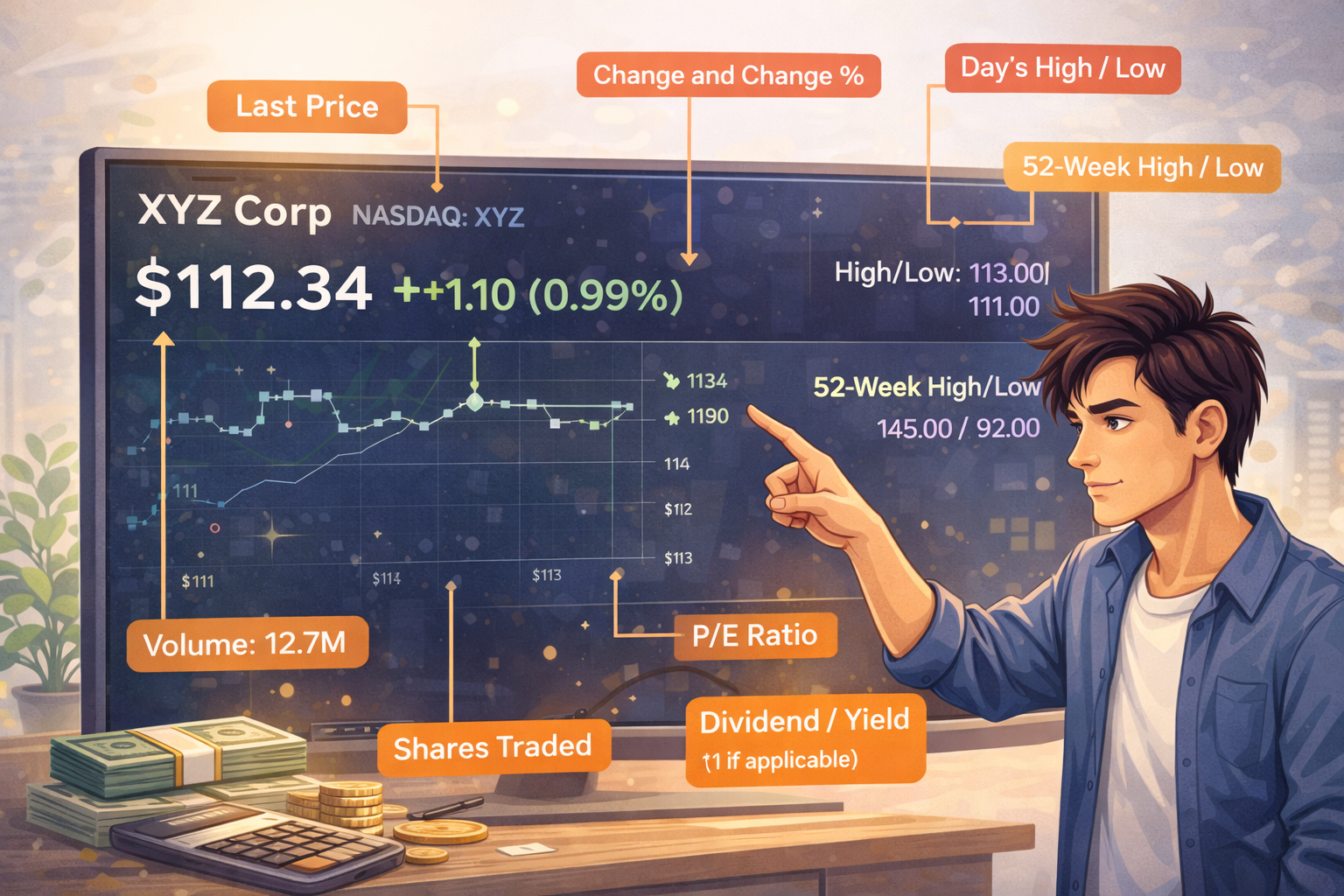
When you look up a stock, you see a bunch of numbers and terms on one screen. This is called a stock quote. Knowing how to read a basic stock quote helps you understand what is happening with a stock’s price, how much it has moved, and how active it is today.
What Is a Stock Quote?
A stock quote is a small summary of key information about a stock at a given moment. Most basic quotes show:
The current or last traded price.
How much the price has changed today.
How many shares have traded.
Different websites and apps may arrange things differently, but the main pieces are similar.
Ticker Symbol
The ticker symbol is the short code that identifies the stock. For example, a company might trade under “AAPL” or “MSFT.” This code is what you type into your app or website to look up the stock. Every publicly traded company has at least one ticker symbol.
Last Price, Change, and Percent Change
Last price: The most recent price at which a share traded.
Change: How much the price has moved today in dollars, such as +$1.20 or −$0.75.
Percent change: The change shown as a percentage, such as +2.5% or −1.3%.
These three numbers tell you what the stock is currently selling for and how it is doing compared with yesterday’s close.
Bid, Ask, and Bid-Ask Spread
Bid: The highest price someone is currently willing to pay to buy.
Ask (or offer): The lowest price someone is currently willing to accept to sell.
Bid-ask spread: The gap between the bid and the ask.
A small spread usually means good liquidity and active trading. A large spread can mean fewer traders and more risk of getting a price you do not expect.
Volume and Day’s Range
Volume: How many shares have traded so far today. Higher volume usually means more activity and interest in the stock.
Day’s range: The lowest and highest prices the stock has traded at so far today. This shows how much it has moved within the current session.
Many quotes also show a 52-week range, which is the lowest and highest price over the past year. That gives longer-term context.
Other Common Items
Some quotes also include:
Market cap: The total value of all shares (company size).
Dividend and yield: Recent dividend payment and its yield, if the company pays dividends.
P/E ratio: Price-to-earnings ratio, a simple valuation measure.
These help you go beyond today’s price and think about size, income, and valuation.
Takeaway
A basic stock quote is a quick snapshot of a stock: ticker, last price, daily change, bid and ask, volume, and trading range. Learning how to read a stock quote helps beginners see what is happening with a stock at a glance and ask better questions about risk, activity, and price moves, while remembering that any stock can go up or down in value.
Not financial advice. Educational purposes only.